Day 1: US SAN FRANCISCO – PARIS
Passengers will gather at the airport to check in for their flight to Paris. Passengers will rest on the plane.
Day 2: PARIS CITY TOUR (DINNER)
Upon arrival at Charles De Gaulle Airport, you will complete immigration procedures and begin your tour of Paris:
- Miraculous Medal Church – The Miraculous Image – the place where the Virgin Mary appeared to Saint Catherine Laboure in 1830. The Virgin Mary entrusted her with the mission of promoting veneration of her through this image, often called the “Miraculous Image.” She promised: “All who carry this image with complete trust will receive many great graces.” The heart of Saint Vincent de Paul is also preserved here.
- Visiting the Paris Foreign Missions Society (MEP), From this place, priests brought the light of the Gospel to Vietnam and visited the museum commemorating the Vietnamese Martyrs.
The group had lunch and continued their sightseeing:
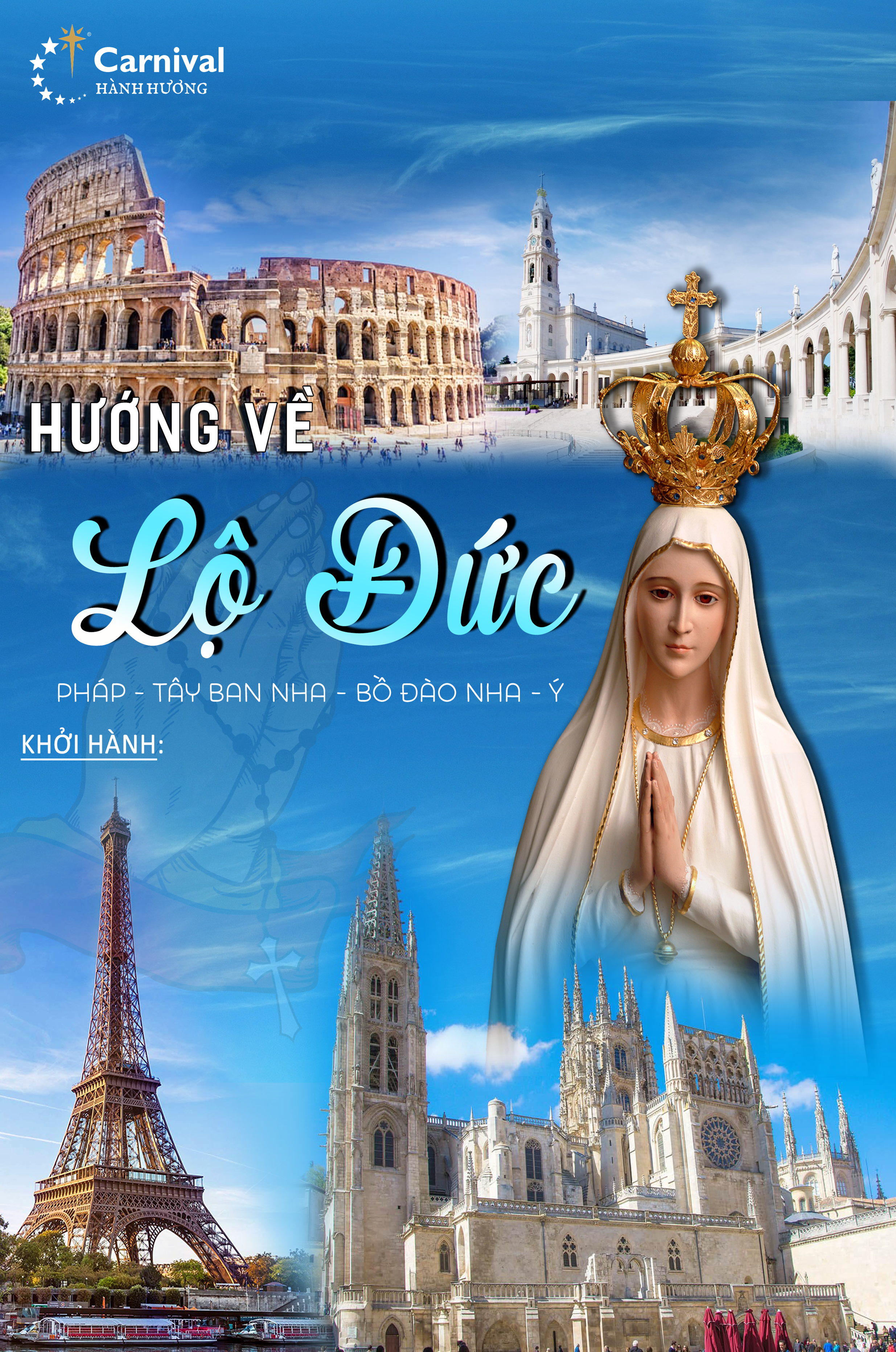
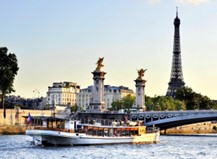
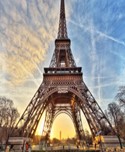
- Take souvenir photos next to the Eiffel Tower (the tower is a 1-minute walk from the ferry terminal). – a 325-meter-high steel structure located in the Champ-de-Mars park, next to the Seine River in Paris. This structure was built by Gustave Eiffel and his colleagues for the 1889 World's Fair, which also commemorated the 100th anniversary of the French Revolution.
- Take a romantic cruise on the Seine River in a Bateaux Parisiens boat. – Admire the architectural landmarks along the riverbank such as the Eiffel Tower, Notre Dame Cathedral, the Louvre Museum… This unique journey offers you a panoramic view of the ancient city of Paris.
The group had dinner, then returned to the hotel to check in and rest. Overnight stay in Paris.
Day 3: Paris City Tours (Breakfast + Dinner)
After having breakfast at the hotel, you will depart.
- Montmartre Hill – This beautiful hill, once a source of inspiration for many famous painters and musicians such as Picasso, Modigliani, Van Gogh, Renoir… was originally called the “Martyr Hill,” where Parisians paid their respects to Saint Denis.
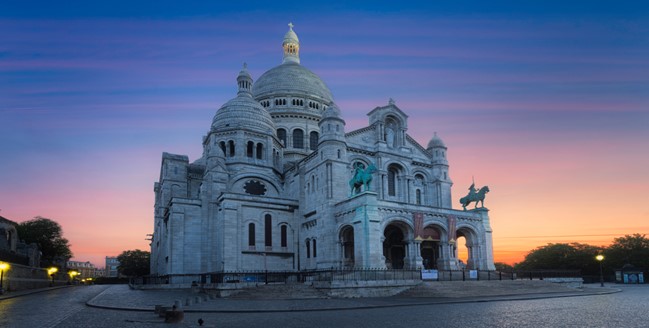
- Sacre Coeur Basilica Built in the late 19th and early 20th centuries, its pristine white facade against the blue French sky has become an iconic symbol of Paris. The cathedral is decorated in the Roman-Byzantine style with vibrant stained-glass windows dating from 1920-1930. The Sacre Coeur bell tower houses the Savoyarde bell, the largest in France. Situated on a hilltop, the cathedral offers stunning panoramic views of Paris.
- A private Mass was celebrated for the group.
The group had lunch and continued their sightseeing:
- Sightseeing Basilica of the Sacred Heart of Jesus. Triumphal Arch Square..
- Avenue Champs Elysée
The group had dinner, then returned to the hotel to check in and rest. Overnight stay in Paris.
Day 4: PARIS – LISIEUX – PARIS (BREAKFAST + DINNER)
After breakfast at the hotel, the group will depart for Lisieux town for a visit:
- Carmelite Couvent Chapel: Visiting the tomb of Saint Thérèse of Lisieux.
- St. Therese BasilicaThe idea behind building this magnificent cathedral was to honor the canonization day of Saint Thérèse.
- St. Peter's Church: The church is designed in the classical Gothic style. Inside this church is the tomb of Bishop Pierre, who was involved in the trial of Saint Janne D'Arc.
After lunch, the group returned to Paris to continue sightseeing:
- Notre Dame Cathedral – Notre Dame Cathedral in Paris: Located on the Ile de la Cité island in the middle of the Seine River, this cathedral was built between 1103 and 1250. This Gothic-style cathedral features large stained-glass windows that let in sunlight. The facade of the cathedral has stone sculptures depicting the Virgin Mary with the infant Jesus, Jesus with his disciples, the Resurrection, and Judgment Day.
The group had dinner and returned to the hotel to check in and rest. Overnight stay in Paris.
Day 5: PARIS – LOURDES (BREAKFAST + DINNER)
Guests will have breakfast at the hotel. The bus will take the group to the train station to board the TGV train to Lourdes, a small city in southwestern France known worldwide for the apparition of the Virgin Mary to Bernadette Soubirous in 1854. Lunch will be served on the train. Arrival. Lourdes, tour group:
- Basilica of the Immaculate Conception – The Basilica of Immaculate Conception – is located on the mountaintop, just behind the Massabielle cave and above the Basilica of Our Lady of the Rosary, and is therefore also known as the Upper Church.
- The underground church is named after Pope Pius X. – with a capacity of 20,000 people.
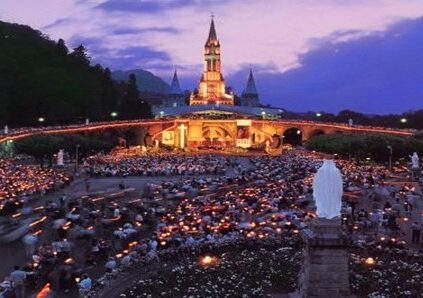
The group returned to the hotel for dinner, then participated in the collective procession with the community. Spend the night in Lourdes.
Day 6: LOURDES (BREAKFAST + DINNER)
After breakfast at the hotel, the group will depart for sightseeing.
Attend daily Mass.
- Our Lady of the Rosary Church in Lourdes – This church is particularly famous for its sacredness, especially the statue of Our Lady of Lourdes in the grotto. It is this church that has given the city of Lourdes a unique spiritual importance in the world.
- Cave of the Virgin Mary's Apparition – Grottes de L'apparition, also known as Grotte Massabielle, is a cave where the Virgin Mary is said to have appeared to Saint Bernadette.
- Join the Stations of the Cross – The Way of the Cross – the 2 km long Way of the Cross – depicts the 15 stations that Jesus went through.
The group had dinner and spent the night in Lourdes.
Day 7: LOURDES – BURGOS (BREAKFAST + DINNER)
After breakfast, the group departs for Burgos, a sanctuary of ancient churches. Upon arrival in Burgos, the group will have lunch at a restaurant. Following lunch, they will begin a city tour of Burgos.
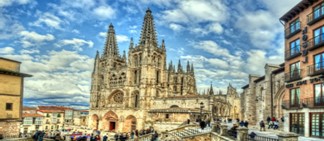
- Burgos Cathedral - One of Spain's three largest cathedrals, Burgos Cathedral was built between 1221 and 1567. It seems that the entire history of classical Gothic architecture is encapsulated in this magnificent structure, along with its unique collection of artworks, including paintings, tombs, and distinctive stained-glass windows. It also houses the tombs of King Fernán González and El Cid – two famous national heroes who fought against the Moors from the 8th to the 11th centuries.
- Old Quarter Paseo de la Isla Picturesque, with parks along the riverbank.
Guests will have dinner and check into their rooms for the night. Overnight stay in Burgos.
Day 8: BURGOS – FATIMA (BREAKFAST + DINNER)
The group will have breakfast and check out of the hotel. Depart for Fatima. Upon arrival in Fatima, guests will have lunch and visit:
- Holy Trinity Church – The Church of the Most Holy Trinity, inaugurated on October 12, 2007, to commemorate the 90th anniversary of the apparitions of Our Lady of Fatima, is the largest church in Portugal and the fourth largest Catholic church in the world.
- Basilica of Our Lady of the Rosary.
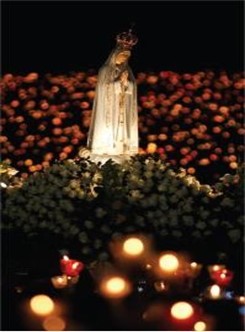
- Evening attendance The ceremony included a procession of the Virgin Mary and an evening candlelight vigil, with thousands of pilgrims coming from all over the world.
Spend the night in Fatima.
Day 9: FATIMA (BREAKFAST + DINNER)
Have breakfast at the hotel. Spend the whole day participating in community activities.
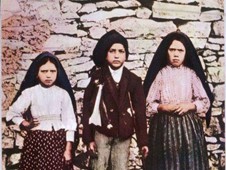
Visiting the home of the three children, Jacinta, Lucia, and Francisco.
Have dinner and rest at the hotel. Participate in the solemn procession. Overnight stay in Fatima.
Day 10: FATIMA – SANTAREM – LISBON (BREAKFAST + DINNER)
Guests will have breakfast and check out. The vehicle will then transfer the group to:
- Santarem, where the Eucharistic Miracle occurred in 1266, visits the Shrine of the Eucharistic Miracle.
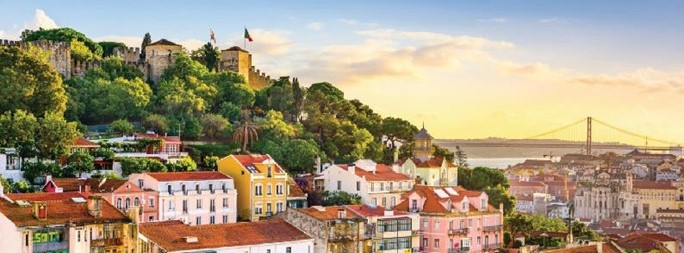
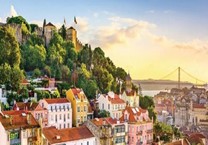
The tour bus will take the group to Lisbon – the capital and largest city of Portugal. This coastal city has a long history, famous for the "Age of Discovery" in the 15th and 16th centuries when a series of renowned navigators from Lisbon conquered the shores of various continents, bringing wealth and prosperity to Portugal. Guests will have lunch and then visit:
- The port and city of Lisbon.
Guests will have dinner and check into their rooms for rest. Overnight stay in Lisbon.
Day 11: LISBON – ROME (BREAKFAST + DINNER)
Guests will have breakfast and then go sightseeing:
- Lisbon Cathedral: It was built by the first king of Portugal, D. Afonso Henriques, in the 12th century.
- Chapel of St. Anthony of Podova.
The bus will take the group to the airport for the flight to Rome. Upon arrival in Rome, guests will check into their hotel, have dinner, and have free time to explore and shop in the Eternal City.
Spend the night in Rome.
Day 12: ROME CITY TOUR (BREAKFAST + DINNER)
After breakfast at the hotel, the group will depart for sightseeing:
- Calisto Catacombs: Pope Zeferino (199-217) entrusted the care of the catacombs to Deacon Callistus. Later, Deacon Callistus was elected Pope, succeeding Pope Zeferino and governing the Church (217-222) until Callistus's martyrdom and burial in this cemetery. In the 3rd century, nine Roman bishops were buried in the Catacombs of St. Callistus, also known as the Papal Chapel. In total, 46 popes and over 170,000 martyrs are buried here, including the tomb of St. Cecilia.
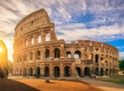
- Colosseum: The grand amphitheater in Rome, built between approximately 70 and 72 AD during the reign of Emperor Vespasian, has weathered many historical upheavals. The Colosseum still stands there today.as a masterpiece of time. (Taking souvenir photos outside)
- Spanish Square Known as the "tourist heart" of Rome, this area attracts the most visitors, who come to see the Holy Trinity Church atop a hill, its winding steps leading to a fountain in the center depicting the majestic Sea King on a stone boat. It's an ideal meeting place for everyone.
- Taking photos outside the Pantheon.The temple, dedicated to the virgin goddess Athena, was built around the middle of the 5th century BC.
- Take photos outside. Arch of Constantine.
- Take photos outside. Circus Maximus – The largest horse racing track of ancient Rome.
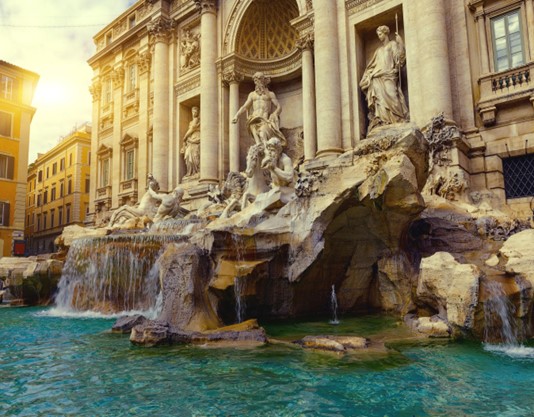
- Trevi Fountain – the setting for classic films like "La dolce vita" or "Three coins in the fountain," many tourists today also come with the hope of finding eternal love, just like what they have seen in those movies.
Have dinner and return to the hotel to rest. Overnight stay in Rome.
Day 13: ROME – ASSISI – ROME (BREAKFAST + DINNER)
The group will have breakfast at the hotel, then the bus will take you to visit Assisi.
- Basilica of Our Lady of the Angels: Outwardly simple, the interior is very spacious, with many small chapels and numerous beautiful statues and paintings. This is where Saint Francis, in his youth, discerned his vocation, renounced the world to live in poverty among the poor, and began the Franciscan movement. After the saint's death in 1226, the friars built small huts around Porziuncola. In 1230, a refectory and several adjacent buildings were added. Inside the church is "The Portiuncola," considered the first mother house, where Saint Francis founded the Order of Friars Minor. The small 9th-century church, Porziuncola, is the holiest place for Franciscan friars. As pilgrims came to Assisi in increasing numbers to receive the "Assisi Indulgence," the small space of Porziuncola was no longer sufficient. The need arose to build a new church to be combined with Porziuncola. By order of Pope Pius V (1566-1572), the buildings surrounding the sanctuary were dismantled, except for the Transito chapel and the room where Saint Francis died. The group had lunch and continued their tour.
- Basilica of St. Francis of Assisi: Construction began in 1228 on the Basilica, situated beside a hill and comprising two parts: the Upper Church and the Lower Church. It contains a crypt where the saint's tomb is located. The interior decoration of the Upper Church is in the Italian Gothic style. Both the upper and lower churches are adorned with frescoes by renowned Romanesque and Tuscan painters of the late period. There is a series of 28 frescoes by the young artist Giotto along the lower part of the nave. The artist based his work on Saint Bonaventure's *Legenda Maior*, a biography of Saint Francis (1266), to recreate major events in the saint's life. Since 2000, UNESCO has recognized this Basilica as a World Heritage Site.
- St. Clara Basilica: The Basilica of St. Clare was built in the Italian Gothic style between 1257 and 1257. Traditionally, this crucifix called upon Francis to “revive the Church” in the Church of St. Damiano. From the left of the sanctuary, there is a passage leading down to the crypt. Here lies the tomb of St. Clare. Several special relics are preserved here, including the habit of St. Francis and the religious garment of St. Clare.
- Basilica of St. Rufinus: (There is a baptismal font where Saints Francis and Clare received the Sacrament of Baptism; the church also houses a Pietà in the style of 15th-century German art.) The Basilica of Saint Rufino is of great importance in the history of the Order. Saint Francis, Saint Clare, and many of his early disciples were baptized here. In 1209, Clare was moved by Francis's message and heeded his call. The group set off for Rome – the capital and the leading economic, cultural, commercial, and political center of Italy.
The group departs for Rome (200km), has dinner, and checks into the hotel for rest. Overnight stay in Rome.
Day 14: ROME – VATICAN – ROME (BREAKFAST + DINNER)
Guests will enjoy a buffet breakfast at the hotel, then depart for sightseeing:
- Attending the Audience with the Pope.
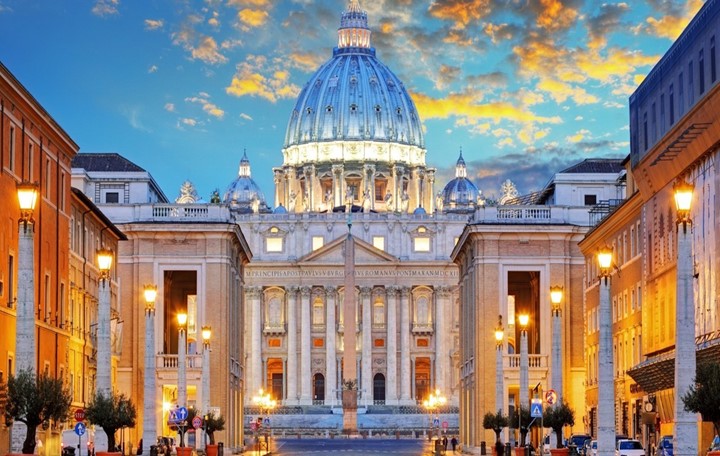
- St. Peter's BasilicaOne of the Four Great Basilicas in Rome. The first basilica was built by Emperor Constantine in 320. The current basilica was built over 120 years (1506-1606) during the reigns of 18 papacies under the direction of 12 famous architects such as Bramante, Michelangelo, Raffaello, and Maderno. It is the largest and most beautiful basilica in the world. Basilica of Santa Maria Maggiore – St. Mary Major's Basilica – one of Rome's four major basilicas, built in the 4th century. According to legend, the Virgin Mary appeared to John and Pope Liberius (352-366) and asked them to build a church in her honor and the place where the snow fell on the Esquilino Hill around the night of August 4th and the morning of August 5th, 358. Therefore, the people venerated her with the title "Our Lady of the Snow," later changed to "Our Lady of God" after the Council of Ephesus proclaimed the dogma of Our Lady of God in 431. This is the only basilica in Rome that still retains its original architectural features. It houses a wooden manger where Jesus lay at his birth in Bethlehem.
- Basilica of St. John Lateran – After issuing the Edict of Milan in 313 granting the Catholic Church religious freedom throughout the Roman Empire, Emperor Constantine commissioned the construction of the Basilica of Lateran between 313 and 318 to honor the Savior. This is the Mother and Head (Mater et Caput) of all churches in the world. During the pontificate of Pope Gregory I (590-604), the basilica was dedicated to both Saint John the Baptist and Saint John the Apostle. Pope Lucius II established its current name, the Basilica of St. John Lateran, in 1144. From the 4th to the 14th centuries, this basilica was the center of the Roman Church, the seat and symbol of the Pope.
- Holy Stairs – According to tradition, Jesus ascended the steps to be judged by Pilate in his palace, and the blood of Jesus was found on the steps. On the Holy Stairs is the Holy Chapel containing very precious relics.
- Sightseeing Church of the Holy Cross Jerusalem
Have dinner and return to the hotel to rest. Overnight stay in Rome.
Day 15: ROME – US (BREAKFAST)
Have breakfast and attend Mass daily.
At the scheduled time, the group will depart for the airport to catch their flight back to the US. Crossing the international date line, you will arrive back in the US on the same day.