
Places & Experiences
Ancient Corinth Travel Guide – St. Paul, History & Greek Heritage
Ancient Corinth – Where Greek History Meets the Story of St. Paul
There are destinations that are remembered for their scenery, while others are defined by the stories that took place there. Ancient Corinth belongs to both categories. Located on the narrow isthmus connecting mainland Greece with the Peloponnese, Corinth was once one of the most important cities of the ancient Mediterranean, shaped by its strategic position between two seas and its role as a major center of trade and cultural exchange. Today, its archaeological remains offer travelers a remarkable opportunity to explore the world of ancient Greece while also discovering a place deeply connected to the early history of Christianity.
For Christian travelers, Corinth holds an even greater significance because of its connection with St. Paul. The Apostle spent a substantial period of his missionary journey in the city, establishing a Christian community that would later become the subject of his well-known letters to the Corinthians. Visiting the ruins today creates an unusual connection between geography, history, and Scripture: instead of encountering Corinth only through the pages of the Bible, travelers can stand within the landscape where this important chapter of early Christianity unfolded.
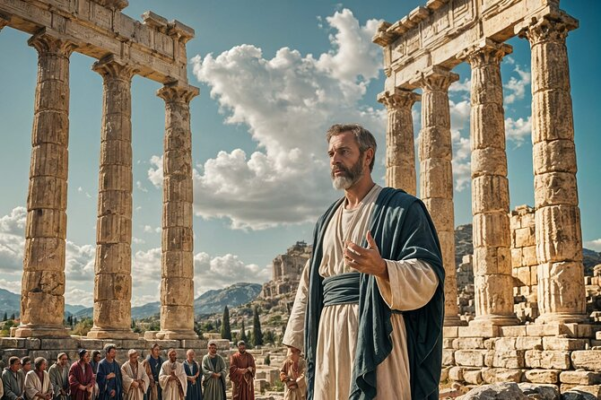
Corinth and Its Importance in the Ancient Mediterranean
Long before St. Paul arrived in Corinth, the city had already developed into an influential center of the ancient Greek world. Its location was one of its greatest advantages. Situated near the narrowest point of the Greek mainland, Corinth controlled important routes between northern and southern Greece while also providing access to maritime trade through the nearby Gulf of Corinth and Saronic Gulf. This strategic position allowed the city to become a meeting point for merchants, travelers, and communities from different parts of the Mediterranean.
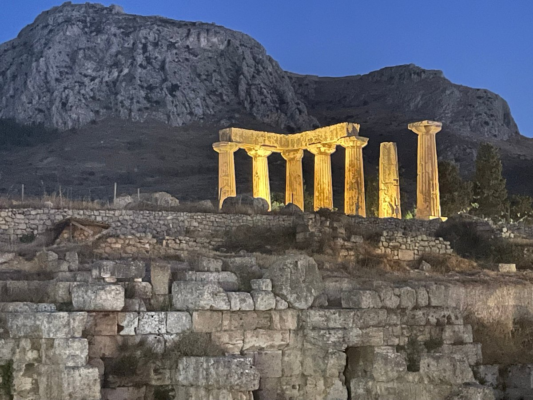
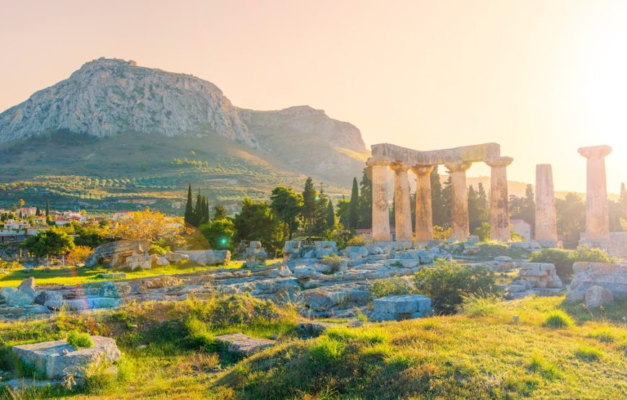
The archaeological remains visible today reveal just how developed this ancient city once was. Visitors can walk through the remains of streets, public spaces, temples, fountains, and other structures that formed part of Corinth’s urban landscape. Among the most recognizable monuments is the Temple of Apollo, whose surviving columns provide a striking reminder of the city’s long history before the arrival of Christianity. Exploring these ruins gives travelers a better understanding of the cultural and religious environment in which the early Christian community would eventually emerge.
This historical context is important when considering Corinth as a pilgrimage destination. Christianity did not develop in isolation from the societies around it; the early Church grew within cities that already had established religious traditions, political structures, intellectual cultures, and extensive networks of communication. Corinth therefore represents more than an ancient archaeological site. It provides a window into the complex Mediterranean world in which Christianity first began to spread.
St. Paul in Corinth
The story of St. Paul gives Corinth another layer of historical and spiritual significance. According to the Acts of the Apostles, St. Paul stayed in Corinth for approximately eighteen months during his missionary work, making the city one of the important locations in his journey through the Mediterranean. During this period, he preached to the local community and helped establish a Christian congregation whose experiences would later become the subject of two of the best-known letters in the New Testament.
The First and Second Epistles to the Corinthians provide an extraordinary connection between the ancient city and the Christian tradition that continues today. The letters address questions of faith, community, morality, relationships, and Christian life, offering an insight into the challenges faced by one of the earliest Christian communities. For travelers who have encountered these texts through Scripture, visiting Corinth can therefore change the way the story is understood by placing it within a real geographical and historical setting.
This is one of the qualities that makes pilgrimage travel different from ordinary sightseeing. A historical name that may have previously existed only in books or Scripture becomes a physical place that can be explored. The surrounding landscape, archaeological remains, and surviving landmarks help travelers imagine the society in which St. Paul lived and preached, creating a more tangible connection between the past and the present.
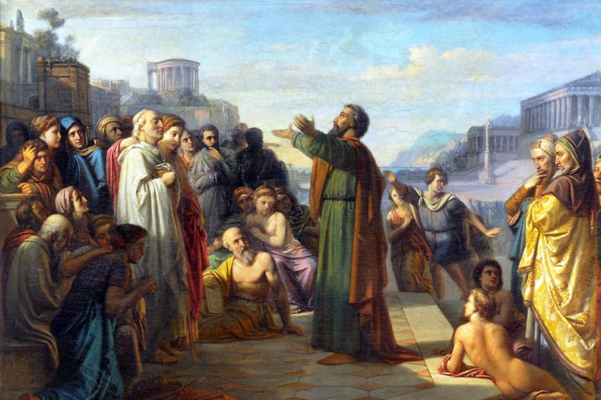
The Bema and the Memory of St. Paul
Within the archaeological site, the Bema is one of the locations that holds particular interest for visitors following the story of St. Paul. The raised platform formed part of the ancient public forum and is traditionally associated with the Apostle’s appearance before the authorities of Corinth. While the site must be understood within its wider archaeological and historical context, its connection with the biblical narrative makes it especially meaningful for Christian pilgrims.
Standing in this ancient public space allows visitors to consider how different the world of the first-century Mediterranean was from the one we know today, while also recognizing how many aspects of human experience remain familiar. Corinth was a busy, diverse city where people from different backgrounds interacted, traded, debated, worshipped, and formed communities. It was within this environment that the early Christian message was introduced, making Corinth an important example of how Christianity spread through the interconnected cities of the ancient Mediterranean.
The Corinth Canal – A Landscape Shaped by Geography
The experience of visiting Corinth does not end with the archaeological site. Not far away, the Corinth Canal cuts dramatically through the Isthmus of Corinth, connecting the Gulf of Corinth with the Saronic Gulf. Although the canal was completed in the nineteenth century – many centuries after the ancient city reached its height – it demonstrates that the geographical importance of Corinth has continued throughout history.
The narrowness of the isthmus has always influenced the way people moved through this part of Greece. In antiquity, Corinth benefited from its position along important land and maritime routes; in the modern era, the canal transformed the passage between the two gulfs into a navigable waterway. Seeing the ancient ruins alongside this modern engineering achievement offers travelers an interesting perspective on how the same landscape has continued to shape human movement for thousands of years.
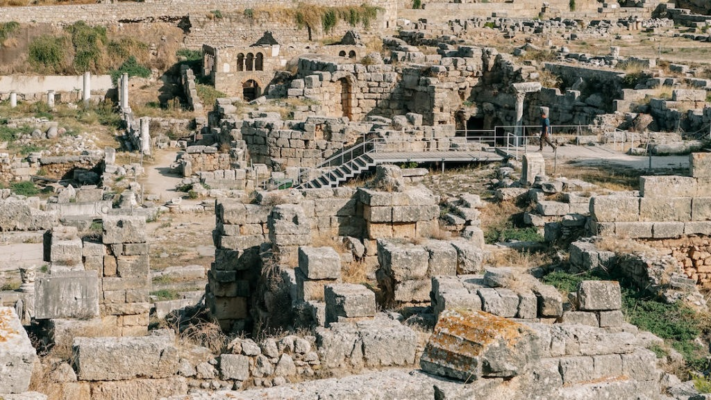
Why Ancient Corinth Matters to Pilgrimage Travel
Ancient Corinth is particularly compelling because several different chapters of Mediterranean history exist within the same destination. The archaeological remains reveal the importance of ancient Greek civilization, while the Roman-era history of the city provides the setting in which St. Paul’s Christian community developed. The biblical connection then gives the site a personal dimension for pilgrims who want to understand more deeply the world in which the early Church began to take shape.
Rather than treating these elements as separate attractions, travelers can experience them as parts of one continuous story. The Temple of Apollo represents the religious traditions of the ancient world; the streets and public spaces reveal the complexity of Corinthian society; and the sites associated with St. Paul connect this historical landscape with the development of early Christianity. Together, they create a destination that can appeal equally to travelers interested in archaeology, history, culture, and faith.
For those following the footsteps of St. Paul, Corinth can also become a moment of reflection. His journey was not simply a movement between geographical points; it was a journey through diverse cultures and communities, each with its own traditions and challenges. Visiting the places associated with that journey offers modern travelers an opportunity to consider how faith, culture, and human connection have crossed borders throughout history.
Ancient Corinth as Part of a Mediterranean Journey
Corinth becomes even more meaningful when it is experienced as part of a wider journey through the Mediterranean rather than as an isolated day trip. Carnival US Travel’s Follow in the Footsteps of Saint Paul itinerary connects Corinth with Athens, Rome, Mykonos, Patmos, Ephesus, and Santorini, creating a journey that brings together ancient history, Christian heritage, Greek island culture, and the landscapes of the Aegean. Explore Follow in the Footsteps of Saint Paul
The itinerary also creates an interesting geographical progression. Rome introduces travelers to the heart of Catholic heritage, while Athens provides a window into the intellectual and cultural world of ancient Greece. From there, the journey continues across the Aegean, bringing travelers to islands and historical sites connected with the early Christian world before returning to Corinth. Each destination contributes another part of the story, allowing the journey itself to become a way of understanding the Mediterranean.
This combination is what makes a pilgrimage journey particularly distinctive. Travelers are not simply moving from one famous destination to another; they are following a historical thread that connects cities, islands, cultures, and communities. The scenery of the Mediterranean becomes part of the experience, but so do the stories preserved within each destination.
A Journey Beyond the Ruins
At first glance, Ancient Corinth may appear to be a place of ruins, columns, and archaeological remains. Yet the more visitors understand the history of the city, the easier it becomes to imagine the life that once existed there. Merchants traveled through its streets, ships moved through the surrounding waters, communities gathered in its public spaces, and early Christians attempted to build a new community within a complex and diverse society.
That is ultimately what makes Corinth such a rewarding destination. Its importance does not come from a single monument, but from the layers of history that have accumulated in the same landscape. Ancient Greek civilization, Roman history, Mediterranean commerce, and the story of early Christianity all meet here, allowing travelers to experience a destination that is much richer than its archaeological remains might initially suggest.
For pilgrims, walking through Ancient Corinth can therefore become more than a sightseeing experience. It can be an opportunity to place familiar stories within their historical setting, to reflect on the journeys of the people who came before us, and to understand how the Christian faith traveled through the cities and cultures of the ancient Mediterranean.
Some places tell you what happened there. Ancient Corinth invites you to imagine the people, communities, and journeys that made its history possible.
Discover Ancient Corinth with Carnival US Travel
If you want to experience Greece through more than its landscapes and famous landmarks, Ancient Corinth offers a destination where history and faith come together naturally. As part of Carnival US Travel’s Follow in the Footsteps of Saint Paul journey, Corinth is connected with Athens, the Greek Islands, Patmos, Ephesus, and Rome, creating a broader exploration of the Mediterranean world and the places associated with the early Christian Church.