
Pilgrimage Blog/Post
Following the Footsteps of St. Paul – A Journey Across Italy, Greece and the Aegean
A journey inspired by St. Paul is not simply a journey from one destination to another. It is a journey through the places, cultures, and communities that formed the landscape of early Christianity. From the historic streets of Rome to the ancient cities of Greece and the islands scattered across the Aegean, each destination offers a different perspective on a story that began nearly two thousand years ago and continues to inspire travelers today.
What makes this journey particularly remarkable is the contrast between the places along the way. Rome introduces travelers to the heart of Catholic heritage, while Athens reveals the intellectual world of ancient Greece. Corinth connects the journey directly with the communities visited by St. Paul, while Patmos and Ephesus add further chapters to the story of early Christianity. Between these historic destinations are the landscapes of the Mediterranean – the Aegean Sea, Greek Islands, coastal towns, and centuries-old cities that make the journey as visually memorable as it is meaningful.
For travelers, the experience is therefore about more than following a historical route. It is about discovering how history, faith, culture, and geography come together to create a journey that feels connected from beginning to end.
Every Journey Begins With a Story
Before arriving at any destination, there is usually a reason for going there. For some travelers, it may be the desire to see a famous landmark; for others, it may be a personal connection to a place, a culture, or a story that has stayed with them for years.
Following St. Paul’s journey begins with that same sense of curiosity. His missionary travels took him through a remarkably diverse part of the ancient Mediterranean, connecting cities that were already important centers of commerce, philosophy, religion, and political life. He was not traveling through an empty landscape. He was moving through some of the most dynamic and interconnected communities of the ancient world.
Seeing those places today changes the way the story is understood. A city that may once have existed only as a name in Scripture becomes a real landscape, with streets to walk, ruins to explore, and horizons that help put the historical journey into perspective.
That is what gives a journey like this its distinctive character.
Rome – Beginning at the Heart of Christian Heritage
The journey begins in Rome, a city where ancient history and Christian heritage exist almost side by side.
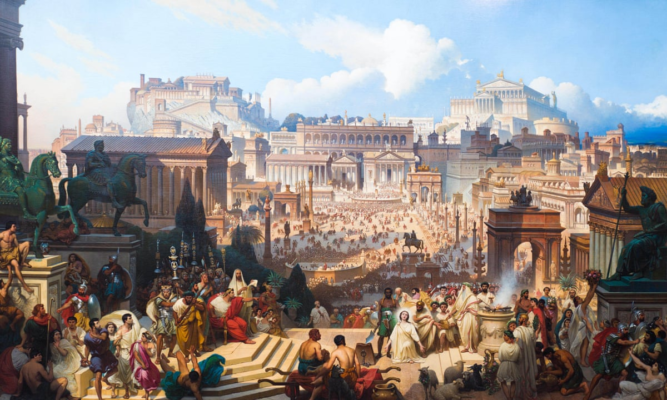
Rome’s importance to the story of Christianity is difficult to overstate. The city became the center of the early Western Church and remains the spiritual heart of Catholicism. For travelers following St. Paul’s story, Rome also carries a personal connection with the Apostle, whose final years and martyrdom are traditionally associated with the city.
Visiting places such as St. Peter’s Basilica and the Basilica of St. Paul Outside the Walls provides an introduction to the Christian heritage that will continue throughout the journey. At the same time, Rome’s ancient monuments offer a glimpse into the Roman world through which St. Paul traveled.
This combination makes Rome a fitting starting point. Before moving eastward across the Mediterranean, travelers encounter the city that would eventually become one of the most important centers of Christianity.
Assisi – Discovering Another Chapter of Faith
From Rome, the journey continues to Assisi, a destination that introduces a different chapter of Christian history.
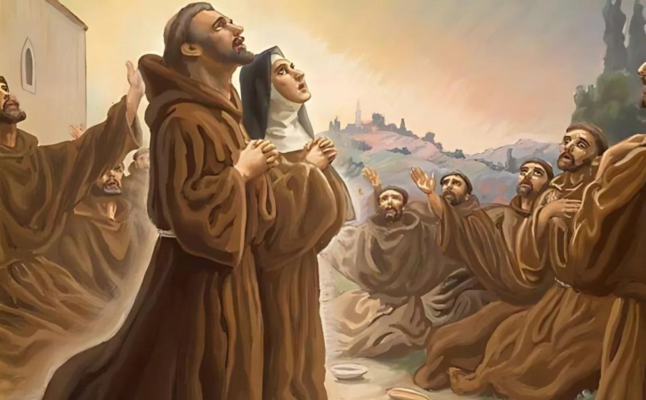
Assisi is best known as the hometown of St. Francis, whose life of simplicity, humility, and service inspired one of the world’s most influential religious traditions. The medieval town, the Basilica of St. Francis, and the surrounding Umbrian countryside create an atmosphere very different from the monumental scale of Rome.
Although St. Francis lived many centuries after St. Paul, including Assisi within a broader Christian journey offers an opportunity to see how Christian spirituality continued to develop long after the days of the early Church. The stories are separated by centuries, but both are connected by journeys that changed communities and inspired generations of believers.
For travelers, this contrast can be one of the most rewarding parts of the experience. The journey is not confined to one historical period; instead, it reveals different chapters in the long history of Christianity.
Athens – Entering the World St. Paul Encountered
The journey then crosses the Mediterranean toward Athens, one of the most influential cities of the ancient world.
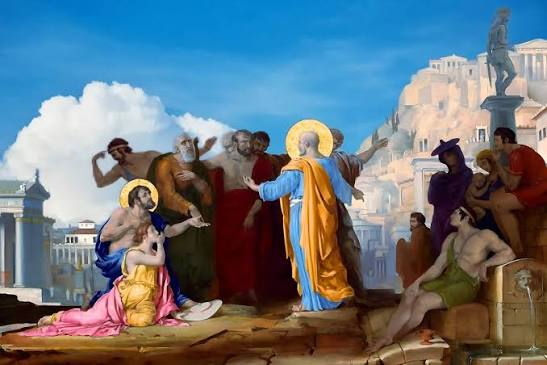
Athens is often introduced through the Acropolis and Parthenon, but for travelers following St. Paul, the city takes on another dimension. The Acts of the Apostles describes Paul’s encounter with the Athenians at the Areopagus, placing him in the middle of a society shaped by philosophy, intellectual debate, and long-established religious traditions.
Standing in Athens today, it is fascinating to consider that same contrast between worlds. The ancient temples and monuments represent a civilization whose intellectual influence continues to shape the modern world, while the story of St. Paul represents the emergence of a Christian movement that would eventually spread far beyond the Mediterranean.
The experience becomes less about simply visiting the Acropolis and more about understanding the environment in which an important chapter of early Christianity unfolded.
Corinth – Where the Story Becomes Personal
If Athens introduces the cultural world of ancient Greece, Corinth brings the journey closer to the communities that St. Paul actually encountered.
Corinth was a thriving city situated at an important crossroads between different parts of Greece and the Mediterranean. Its strategic location brought together merchants, travelers, and communities from different backgrounds, creating the kind of multicultural environment in which new ideas could travel quickly.
St. Paul spent a significant period in Corinth, and the Christian community established there later became the recipient of two of his letters in the New Testament. For travelers familiar with those writings, walking through the archaeological remains can create an unusually tangible connection between Scripture and geography.
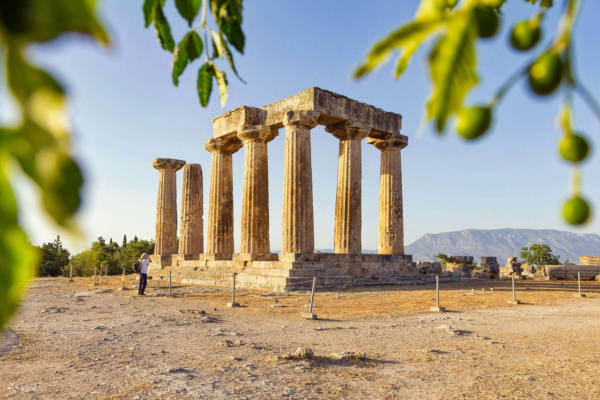
The ruins of the ancient city, the Temple of Apollo, and the sites traditionally associated with St. Paul help transform Corinth from a name in a biblical text into a place that can be physically explored.
This is one of the moments when the journey truly begins to feel like a story being followed rather than a collection of destinations being visited.
Setting Sail Across the Aegean
After exploring mainland Greece, the journey changes pace as travelers move into the Aegean Sea.
Traveling between the Greek Islands offers an experience that is completely different from exploring ancient archaeological sites. The sea becomes part of the journey, while each port introduces another side of Greece and the eastern Mediterranean.
A cruise is particularly well suited to this kind of itinerary because it allows travelers to explore several destinations while maintaining the comfort and continuity of a single base. Instead of repeatedly packing and unpacking, travelers can return to the ship at the end of each day and wake up somewhere new the following morning.
This creates an interesting rhythm. One day may be devoted to ancient history and Christian heritage, while the next offers the opportunity to explore a Greek island, enjoy local cuisine, walk along the waterfront, or simply admire the landscape.
The journey becomes as much about the transitions between destinations as the destinations themselves.
Mykonos – A Different Side of Greece
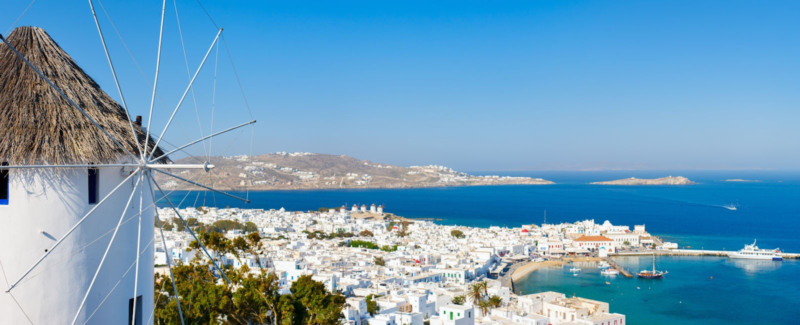
One of the first impressions of the Aegean comes through Mykonos, where the atmosphere shifts from ancient cities to island life.
The whitewashed buildings, narrow streets, traditional windmills, coastal scenery, and lively atmosphere have made Mykonos one of Greece’s best-known islands. Yet within a journey focused on history and heritage, the island provides an important change of pace.
Travelers can step away from archaeological sites and historical narratives for a while and simply experience the Mediterranean. Walking through the town, enjoying Greek food, discovering small shops, or taking in the views across the sea creates space for relaxation within a journey that otherwise contains considerable historical depth.
This balance is important. A meaningful travel experience does not have to be serious at every moment. The opportunity to enjoy the beauty and culture of the destinations along the route is part of what makes the overall journey memorable.
Patmos – A Quiet Moment in the Story
Further across the Aegean, Patmos offers a much quieter experience.
Known as the Island of Revelation, Patmos is traditionally associated with St. John and the Book of Revelation. The Cave of the Apocalypse and the Monastery of St. John the Theologian are central to the island’s identity, while the peaceful landscape provides a natural contrast to the energy of larger cities.
For travelers following a journey through Christian history, Patmos creates a moment to slow down and reflect. The island is not simply another stop on a route; it is a place where the surrounding landscape and religious heritage have remained closely connected for centuries.
Its inclusion in the journey also reminds travelers that the early Christian world was much larger than the places directly associated with one individual. Different apostles, communities, and cities contributed to a network of faith that spread throughout the Mediterranean.
Ephesus – Walking Through an Ancient World
The journey continues to Ephesus, one of the most impressive archaeological destinations in the eastern Mediterranean.
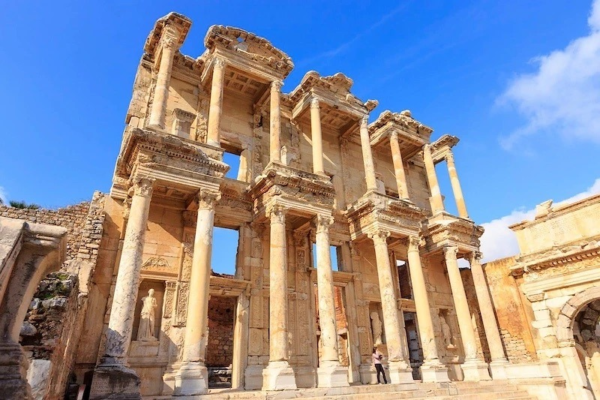
The scale of Ephesus immediately reveals its former importance. Monumental streets, temples, public buildings, and the Library of Celsus reflect a city that was once a major center of commerce and culture. Yet Ephesus also holds an important place in Christian history and is associated with the missionary work of St. Paul.
Walking through the ruins creates a striking contrast between the city’s ancient grandeur and the communities of early Christians who lived within it. The remains allow travelers to imagine the scale of the world into which Christianity spread, while the Christian history of the city adds another layer to what might otherwise be viewed simply as an archaeological site.
It is another reminder that the story of early Christianity unfolded within real cities populated by people with complex cultures and traditions.
Santorini – Ending With the Beauty of the Aegean
After so much history, Santorini offers a different kind of conclusion.
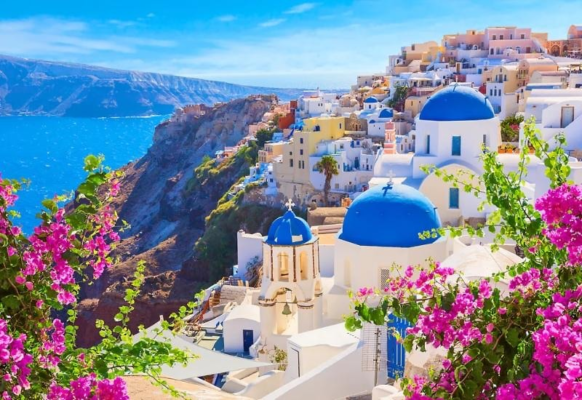
The island is famous for its volcanic landscape, dramatic caldera views, whitewashed villages, and spectacular sunsets. While it does not carry the same direct connection to St. Paul as Corinth or Ephesus, its inclusion adds another important element to the journey: the simple beauty of the Mediterranean.
There is something fitting about ending a journey through history with time to appreciate the landscape itself. After exploring ancient cities and sacred sites, travelers can look across the Aegean, enjoy the atmosphere of a Greek island, and reflect on the many places they have encountered along the way.
The journey may have begun with a historical story, but it ends with an experience that is deeply personal.
When a Tour Becomes a Journey
The difference between a tour and a journey is often found in the connections between the places.
A tour can take travelers to Rome, Athens, Corinth, Patmos, Ephesus, and Santorini. A journey gives those destinations meaning by showing how they relate to one another. Rome becomes the starting point of a Christian story; Athens provides the intellectual landscape of ancient Greece; Corinth reveals one of the communities St. Paul served; Patmos connects the experience with St. John; Ephesus expands the story into Asia Minor; and the Greek Islands provide the Mediterranean landscape that connects them all.
Carnival US Travel’s Follow in the Footsteps of Saint Paul itinerary brings these destinations together through a combination of land exploration and an Aegean cruise, allowing travelers to experience both the historical depth of the route and the beauty of the Mediterranean. Follow in the Footsteps of Saint Paul with Carnival US Travel.
For travelers, that continuity can make the experience feel more meaningful. Rather than returning home with a collection of unrelated photographs, they return with a story – a route that connects different countries, cultures, landscapes, and centuries of history.

The Story You Bring Home
Every traveler experiences a journey differently. One person may remember standing beneath the Acropolis in Athens, another may remember the quiet streets of Assisi, while someone else may remember seeing the Aegean for the first time from the deck of a ship.
What makes a journey like this special is that all of those memories become part of one larger story.
Following the footsteps of St. Paul is ultimately not about trying to recreate an ancient journey exactly as it happened. Modern travelers experience these places from a completely different world, with different technology, comforts, and expectations. Instead, the value lies in using the journey to understand the geography, history, and communities behind a story that has survived for centuries.
And perhaps that is the greatest reason to travel this route.
You do not simply visit the places where history happened. You give yourself the chance to see that history from a new perspective.
Begin Your Own Journey
Carnival US Travel’s Follow in the Footsteps of Saint Paul journey brings together Rome, Assisi, Athens, Ancient Corinth, Mykonos, Patmos, Ephesus, and Santorini in one carefully connected itinerary. It is a journey designed for travelers who want to experience the Mediterranean through a combination of Christian heritage, ancient history, cultural discovery, island life, and the beauty of traveling by sea.
Follow the story across Italy, Greece, and the Aegean – and discover what happens when a historical route becomes your own travel story.