
Places & Experiences
Patmos Travel Guide – The Island of Revelation, St. John & the Aegean
Among the many islands scattered across the Aegean Sea, Patmos has a character that is difficult to define simply through its beaches, whitewashed houses, or beautiful coastal scenery. It is undeniably a Greek island, with the bright sunlight, blue waters, traditional architecture, and relaxed rhythm that travelers often associate with the Aegean. Yet beneath this familiar Mediterranean beauty lies a much deeper story – one that has made Patmos an important destination for Christian travelers for centuries.
Known as the “Island of Revelation,” Patmos is traditionally associated with St. John the Apostle and the Book of Revelation. The island’s spiritual significance is visible in places such as the Cave of the Apocalypse and the Monastery of St. John the Theologian, but the experience of Patmos extends beyond these landmarks. Its peaceful landscape, historic settlement, and distinctive island atmosphere make it a destination where travelers can combine cultural discovery with moments of quiet reflection.
For those exploring Greece by sea, Patmos offers another compelling reason to slow down and step ashore. Rather than being simply another beautiful island on an Aegean itinerary, it introduces a very different kind of destination experience – one shaped by history, faith, and a remarkable sense of place.
Discovering Patmos Through Its Landscape
Patmos is relatively small compared with many of Greece’s better-known islands, and this is part of its appeal. The island does not feel defined by large-scale resorts or urban development. Instead, its landscape is characterized by rugged hills, quiet coves, traditional settlements, and expansive views across the Aegean.
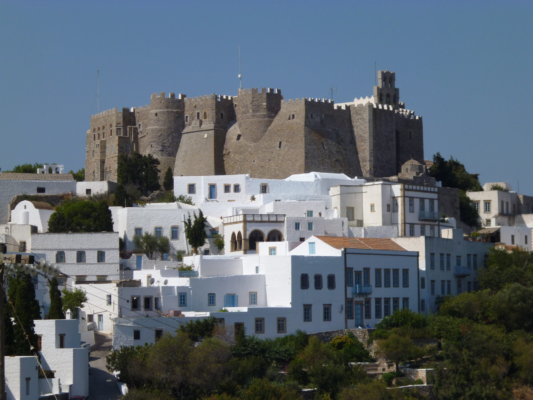
One of the most recognizable sights is Chora, the historic settlement that rises above the island. Its whitewashed buildings and narrow streets reflect the architectural character found across the Greek Islands, while the elevated position offers beautiful views toward the surrounding sea. Walking through Chora provides an opportunity to experience Patmos at a slower pace, discovering small corners of the town rather than simply moving between major attractions.
The sea remains an essential part of the island experience. From viewpoints around Chora and the monastery, the Aegean stretches toward the horizon, creating a sense of openness that contrasts with the narrow streets and stone buildings of the historic settlement. For travelers arriving by cruise, the first view of Patmos from the water can be particularly memorable as the island gradually comes into focus.
Yet it is the relationship between this peaceful landscape and Patmos’s religious history that gives the island its distinctive character.
The Story Behind the Island of Revelation
Patmos is traditionally associated with the exile of St. John the Apostle, who is believed to have received the visions recorded in the Book of Revelation while on the island. This connection has shaped Patmos’s identity for centuries and continues to attract visitors from around the world.
The Book of Revelation occupies a unique place within the Christian Bible. Its symbolic language and visions have inspired generations of theological reflection, art, literature, and religious interpretation. Knowing that the text is traditionally connected with a specific place gives the island an additional dimension for visitors who are familiar with its story.
Traveling to Patmos allows that connection to become geographical. Instead of thinking about Revelation solely as an ancient text, visitors can explore the island’s landscape and see the places that have preserved the memory of St. John. The experience does not require travelers to approach the destination solely from a religious perspective; even visitors interested primarily in history or culture can appreciate how a single historical tradition has shaped an entire island.
This is what makes Patmos different from many other Greek Islands. Its identity has been formed not only by geography, but also by a story that has continued to influence the island for almost two thousand years.
The Cave of the Apocalypse
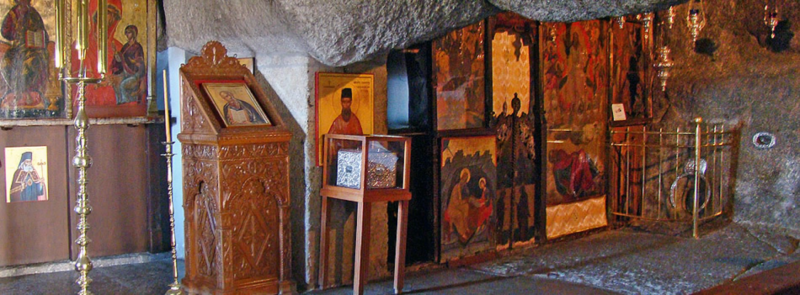
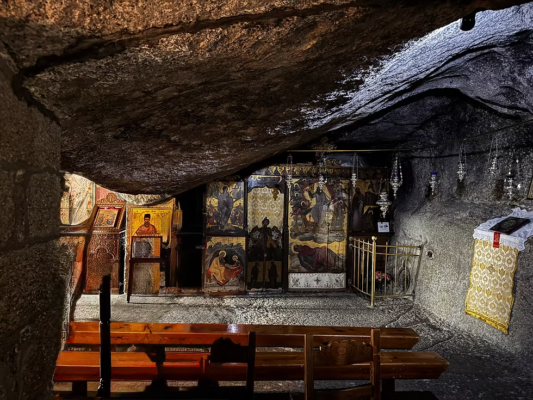
The Cave of the Apocalypse is one of the most significant sites on Patmos and one of the places most closely associated with the island’s Christian heritage. According to tradition, this is where St. John received the visions that became the Book of Revelation.
The site itself has a quiet and intimate character. Rather than resembling a grand cathedral or monumental basilica, the cave is a naturally formed space that has been incorporated into a place of worship. Its simplicity can make the experience particularly striking, especially when considered alongside the enormous historical influence of the text associated with it.
For travelers, visiting the cave also provides an opportunity to understand how religious traditions can shape the cultural identity of a destination. The significance of Patmos is not confined to a single historical moment; it has influenced the island’s architecture, religious institutions, local traditions, and relationship with visitors from around the world.
The experience is therefore as much about understanding Patmos as it is about seeing a particular landmark.
The Monastery of St. John the Theologian
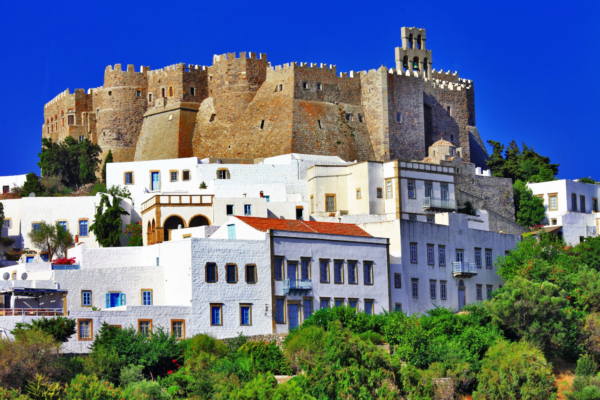
Above Chora stands another defining feature of the island: the Monastery of St. John the Theologian. Founded in the eleventh century, the monastery has played a central role in preserving the religious and cultural heritage of Patmos.
Its fortified appearance reflects the historical realities of life on the Aegean during the medieval period, when monasteries could serve not only as religious centers but also as places of learning and preservation. Inside, visitors can encounter centuries of Christian art, manuscripts, religious objects, and architectural details that demonstrate the monastery’s importance over generations.
The monastery also contributes to the visual identity of Patmos. Seen from the sea, from the surrounding hills, or from different parts of Chora, it stands prominently above the island, connecting the contemporary landscape with its long religious history.
For travelers interested in European heritage, the monastery offers a fascinating example of how religion, architecture, history, and local identity can become inseparable over time.
Experiencing Patmos Beyond Its Sacred Sites
Although the Cave of the Apocalypse and the Monastery of St. John are central to understanding Patmos, the island should not be reduced to its religious landmarks.
Part of the pleasure of visiting Patmos comes from simply walking through Chora, enjoying the views, discovering traditional architecture, and taking time to experience the slower rhythm of island life. Travelers can explore local cafés and restaurants, browse small shops, or simply pause at a viewpoint overlooking the Aegean.
This balance between cultural discovery and relaxation is one of Patmos’s strengths. A visitor can spend part of the day learning about the island’s history and then return to the waterfront for a quiet meal overlooking the sea. The destination does not require constant activity; in fact, its atmosphere often encourages visitors to slow down.
For travelers coming from a cruise ship, this can create a welcome contrast to larger and busier ports. Patmos feels intimate enough to explore at a more personal pace while still offering enough history and culture to make a short visit meaningful.
Patmos as Part of an Aegean Journey

Patmos becomes particularly interesting when experienced as part of a broader journey through the Greek Islands. Each island has its own character, and moving between them allows travelers to see how varied the Aegean can be.
Mykonos offers a lively combination of traditional architecture, coastal scenery, and contemporary tourism, while Santorini is known for its dramatic volcanic landscape and iconic villages overlooking the caldera. Patmos presents something different: a quieter destination where religious history plays a central role in the island’s identity.
Carnival US Travel’s Follow in the Footsteps of Saint Paul journey includes Patmos as part of an Aegean cruise, connecting the island with Athens, Mykonos, Ephesus, Santorini, Corinth, and Rome. The itinerary combines destinations associated with ancient history and Christian heritage with the experience of traveling through the Mediterranean by sea. Explore Follow in the Footsteps of Saint Paul
This kind of itinerary allows Patmos to be appreciated within a larger geographical and historical context. Rather than simply visiting an island because it is beautiful, travelers can understand how Patmos fits into the wider story of the eastern Mediterranean and the early Christian world.
Why Patmos Stays With Travelers
Some destinations impress travelers immediately through dramatic scenery. Patmos works differently.
Its impact often develops gradually, through the combination of its landscape, architecture, history, and atmosphere. The sight of the monastery above Chora, the quiet environment surrounding the Cave of the Apocalypse, and the endless blue of the Aegean all contribute to an experience that feels distinctly different from a conventional island vacation.
For some visitors, the most memorable part may be the island’s religious heritage. For others, it may be the peaceful streets of Chora or the experience of arriving by sea. What connects these different experiences is the sense that Patmos has preserved a strong identity despite becoming an international destination.
That identity is rooted in its history, but it is still very much part of the island’s present.
Patmos reminds travelers that a destination can be beautiful without being defined only by beauty. It can offer scenery while also carrying stories, traditions, and cultural meaning that have survived across generations.
A Greek Island With a Story to Tell
Patmos may be small, but its place in Mediterranean history is anything but insignificant. The island’s connection with St. John and the Book of Revelation has given it a unique identity, while its traditional architecture, historic monastery, peaceful landscape, and Aegean setting make it rewarding for travelers of many different interests.
For those following a journey through the footsteps of the early Christian world, Patmos offers a particularly memorable chapter. It is a place where the sea, landscape, history, and faith come together naturally, allowing visitors to experience a side of Greece that goes beyond the usual image of island holidays.
Perhaps that is what makes Patmos so special. You may arrive expecting another beautiful Greek island, but you leave with an understanding that its most important attraction is not something that can be captured in a photograph.
It is the story the island has carried for centuries.
Experience Patmos With Carnival US Travel
If you are looking for a Mediterranean journey that combines the beauty of the Greek Islands with destinations rich in history and Christian heritage, Patmos offers an experience unlike any other. As part of Carnival US Travel’s Follow in the Footsteps of Saint Paul itinerary, the island becomes one chapter in a broader journey through Rome, Athens, Corinth, Mykonos, Ephesus, and Santorini.
Discover the Island of Revelation and experience the Aegean through a journey where every destination has a story to tell.