
Places & Experiences
Lourdes: A Day of Pilgrimage with Our Lady in the Heart of France
Lourdes – A Different Kind of Stop Along the Journey
In a journey through France, Spain, Portugal, and Italy, every destination brings its own atmosphere, history, and rhythm. Paris introduces travelers to the grandeur and cultural richness of France, Barcelona opens the door to the distinctive character of Catalonia, and later destinations such as Fatima, Assisi, Rome, and Vatican City bring their own dimensions of faith and history. Yet among all these places, Lourdes occupies a particularly meaningful position because it is not simply a destination to be visited before moving on to the next city. It is a place where the journey intentionally slows down and where time is given to prayer, Mass, community, and personal reflection.
As part of the France – Spain – Portugal – Italy Pilgrimage Journey in December 2026, the group spends two nights in Lourdes, allowing the experience to unfold at a different pace from many of the other stops along the route. After beginning in Paris and visiting Montmartre and the Sacré-Cœur Basilica, the group travels by TGV toward Lourdes. Upon arrival, the group is transferred from the train station to the hotel, participates in activities with the community, and celebrates a private Mass. The following day is dedicated entirely to Lourdes before the journey continues toward Barcelona.
This structure is important because time is one of the elements that most strongly shapes the experience of a pilgrimage. When an itinerary moves rapidly from one city to another, it is possible to see many places without necessarily having enough time to absorb any of them. Lourdes is approached differently. Rather than treating the town as a brief stop between Paris and Barcelona, the program creates enough space for pilgrims to remain, participate, pray, and experience the atmosphere of the destination without having to constantly prepare for the next departure.
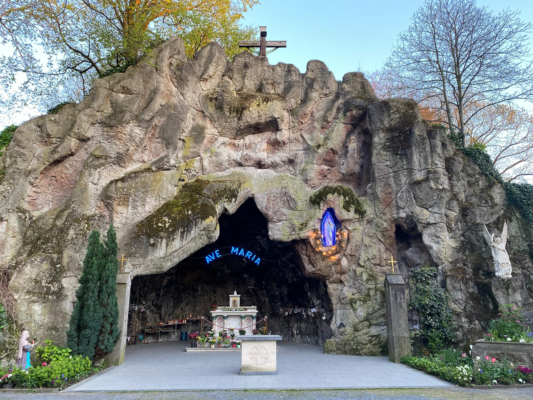
From Paris to Lourdes: When the Rhythm of the Journey Begins to Change
The transition from Paris to Lourdes is one of the more interesting movements within the itinerary because the two destinations offer very different experiences. Paris begins the journey with some of the most recognizable landmarks in France. The group visits the Arc de Triomphe, Notre-Dame Cathedral, and the area around the Eiffel Tower at Champ-de-Mars, while also celebrating a private Mass. Before leaving the capital, the group stops at Montmartre and visits the Sacré-Cœur Basilica before traveling by TGV to Lourdes.
Paris naturally encourages movement and discovery. There are streets to explore, landmarks to photograph, historic neighborhoods to experience, and countless details that compete for a traveler’s attention. Lourdes creates a different rhythm. Once the group arrives, the emphasis shifts more clearly toward the pilgrimage itself, with time to participate in community activities and celebrate Mass rather than immediately moving from one attraction to another.
That change in rhythm is valuable within a long journey. A pilgrimage across several countries inevitably involves transportation, hotel changes, sightseeing, meals, and many different experiences. The journey can be exciting precisely because there is so much to discover, but it can also become physically and mentally demanding if every day follows the same fast pace. A destination such as Lourdes provides a natural pause, allowing travelers to remain in one place long enough for the experience to become more than another item on a schedule.
For pilgrims, this can change the way a destination is remembered. Instead of thinking only about what they managed to see, they may begin to remember what they were able to experience: the time spent inside a sacred space, the Mass celebrated with the group, the opportunity to participate with the community, or the quiet moments in between scheduled activities. These are experiences that cannot always be measured by the number of places visited, but they can become some of the most personal memories of the journey.
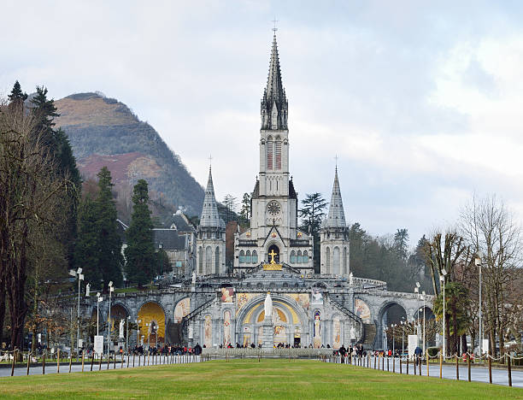
A Full Day in Lourdes: Making Room for Prayer and Reflection
The fourth day of the itinerary is dedicated entirely to Lourdes. The group visits the Basilica of Our Lady of the Immaculate Conception and the underground church named after Pope Pius X, returns to the hotel, and later participates in a communal procession with the community if the schedule permits. A private Mass is also celebrated for the group.
What makes this day different is not the number of activities but the amount of attention that can be given to each one. On a conventional sightseeing itinerary, travelers often move through a destination with the expectation that they should see as much as possible within a limited amount of time. A pilgrimage asks for a different kind of attention. The purpose is not necessarily to fill every hour, but to create enough space for the experience to be lived rather than simply completed.
A visit to a basilica, for example, can certainly be appreciated through its architecture and history, but a pilgrim experiences the same space differently when arriving with a personal intention. Someone may be carrying a prayer for a family member, a concern that has been difficult to express, a desire to give thanks, or simply the hope of finding a moment of peace. The itinerary cannot determine what each person will feel, and it does not need to. Its role is to create an environment in which each person has the opportunity to spend time with those intentions.
This is one of the reasons a full day in Lourdes matters. There is no need to rush through the sacred sites simply because another attraction is waiting on the other side of the city. Instead, the day can unfold around prayer, community, and reflection. The private Mass gives the group a shared moment of worship, while the possibility of joining a communal procession allows pilgrims to experience Lourdes alongside others who have also come to the destination as pilgrims.
The communal aspect is particularly meaningful because pilgrimage is both personal and collective. Each traveler arrives with a different story, but everyone shares the experience of being part of the same journey. People may come from different places and speak different languages, yet they can still stand together in the same sacred space, participate in the same celebration, and carry their individual intentions within a common experience of faith.
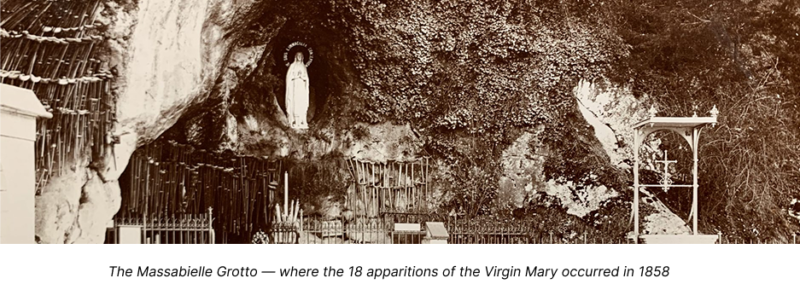
Experiencing Lourdes as a Pilgrim, Not Simply as a Visitor
There is a subtle but important difference between visiting a religious landmark and arriving at a place as a pilgrim. A visitor may be interested in what a church looks like, how old it is, or why it is significant within the history of a city. Those things remain important, but a pilgrim often approaches the same place with another question in mind: what does it mean for me to be here, and what have I come here to bring into prayer?
That question does not necessarily require an immediate answer. In fact, one of the values of a pilgrimage can be the opportunity to sit with questions without feeling pressured to resolve them. A person may arrive in Lourdes knowing exactly what he or she wants to pray for, while another may simply want to be present and allow the experience to unfold naturally. Both approaches can belong to the same journey.
The sacred spaces included in the Lourdes program provide room for that personal experience. The Basilica of Our Lady of the Immaculate Conception and the underground church named after Pope Pius X are not simply places that the group passes through on its way to another destination. They are part of a day specifically designed around the experience of Lourdes. The presence of the community, the celebration of Mass, and the possibility of participating in a procession further reinforce the sense that the group is not merely observing a place of pilgrimage but becoming part of its rhythm for a short time.
For many travelers, some of the most memorable moments may happen outside the formally scheduled activities. A quiet period before or after Mass, a conversation with another member of the group, or simply the experience of walking through the town after a day of prayer can become part of the memory of Lourdes. These moments are difficult to plan in detail, but a well-paced itinerary can make them possible by giving people enough time and space.
Why Two Nights in Lourdes Matter
The decision to spend two nights in Lourdes becomes even more significant when the entire route is considered. This is a journey that crosses four countries and includes a wide range of destinations, from Paris and Barcelona to Zaragoza, Salamanca, Fatima, Lisbon, Assisi, Rome, and Vatican City. With so many places included, time is naturally limited, which makes the decision to remain in Lourdes for two nights particularly meaningful.
The first night allows the group to arrive, settle in, participate in community activities, and celebrate Mass after the journey from Paris. The following day is then dedicated to Lourdes itself, with visits to the basilica and underground church, community activities, a possible communal procession, and another private Mass. Only after that second night does the group depart for Barcelona.
This gives Lourdes a different role from a destination that is visited for only a few hours. The additional time allows the experience to develop naturally instead of being compressed into a narrow sightseeing window. It also gives pilgrims a chance to rest during a demanding multi-country journey while remaining within the spiritual focus of the itinerary.
There is an important distinction here between simply having more free time and having time that has been intentionally built into the journey. The latter can make a meaningful difference because pilgrims know that they do not need to hurry through Lourdes in order to keep up with an ambitious list of attractions. The destination itself has been given enough importance to justify staying longer.
From Lourdes to Barcelona: A Journey That Continues to Change
After the second night in Lourdes, the journey continues toward Barcelona, and the atmosphere changes once again. The itinerary introduces the group to the Sagrada Família, the Basilica of Santa Maria del Mar, Park Güell, the Gothic Quarter, and La Rambla, together with a private Mass for the group.
The movement from Lourdes to Barcelona is a useful reminder that a pilgrimage does not need to separate spiritual experience from cultural discovery. The two can exist naturally within the same journey. A pilgrim may spend a full day in a Marian destination focused on prayer and community, then enter a city where architecture, art, history, and local culture become central to the experience. The contrast between the two places does not weaken the pilgrimage; instead, it gives the overall journey greater variety and allows each destination to retain its own character.
From Barcelona, the group continues to Zaragoza, where the itinerary returns to a stronger focus on Marian devotion through the Basilica of Our Lady of the Pillar and the Sacred Pillar, followed by visits to other historic Catholic sites. Salamanca then offers another combination of religious heritage and historic Spanish culture before the group continues toward Fatima in Portugal.
Seen as part of this larger route, Lourdes becomes an important early chapter rather than an isolated destination. It introduces a slower rhythm before the journey opens again into the cultural richness of Spain and later into the Marian pilgrimage experience of Fatima.
What Makes a Lourdes Experience Stay With You?
It is difficult to predict exactly what each pilgrim will remember after leaving Lourdes. One person may remember the basilica, another the celebration of Mass, another the communal procession if it takes place, and someone else may remember a quiet moment that happened between scheduled activities. What these memories have in common is that they are not necessarily defined by the number of places visited or the amount of information learned during the day.
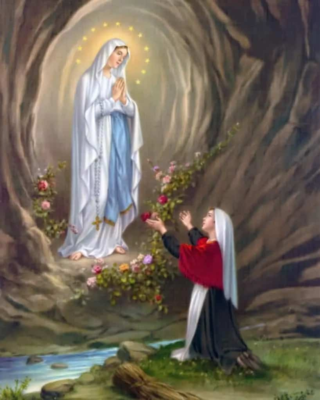
Some experiences become meaningful precisely because they are personal. A person may spend several minutes in prayer without taking a photograph, without speaking to anyone, and without telling the rest of the group what that moment meant. Yet years later, that may be the part of the journey that comes back most clearly.
This is one reason Lourdes can feel different from the other destinations on a multi-country itinerary. The value of the experience is not necessarily found in seeing more, but in allowing the place itself to become part of a personal journey. When there is enough time to remain, the destination can move from being something seen to something experienced.
For travelers who have spent months or even years hoping to make a pilgrimage, that distinction can be especially meaningful. Arriving at Lourdes is one thing; having enough time to actually live the experience is another. The two-night stay and the full day dedicated to Lourdes create that opportunity without requiring every pilgrim to experience the destination in exactly the same way.
Lourdes as a Quiet and Meaningful Chapter of the Journey
The December 2026 France – Spain – Portugal – Italy Pilgrimage Journey brings together a remarkable variety of places, but each destination has its own role within the larger experience. Paris opens the journey with the history and beauty of France, Lourdes creates a period of prayer and reflection, Barcelona introduces the distinctive character of Catalonia, Zaragoza and Salamanca reveal different dimensions of Spanish Catholic heritage, and Fatima continues the Marian pilgrimage experience before the route eventually reaches Lisbon, Assisi, Rome, and Vatican City.
Within that sequence, Lourdes stands out because of the time intentionally given to it. The group does not simply arrive, visit one landmark, and leave. There are two nights in the destination, a full day devoted to its sacred spaces, opportunities to participate with the community, and private Masses for the group. This creates a different kind of travel experience, one in which the schedule leaves enough room for the destination to be experienced rather than simply completed.
Perhaps that is what makes Lourdes such an important part of the journey. It is not necessarily the place where travelers will see the greatest number of attractions, nor does it need to be. Its significance comes from the opportunity to pause within a much longer journey and give time to prayer, community, and personal reflection.
When the group eventually leaves Lourdes for Barcelona, the journey continues with new cities, new landscapes, new churches, and new experiences. Yet the slower rhythm of those days in Lourdes remains an important part of the story. The destination becomes a reminder that a pilgrimage is not defined only by how far we travel or how many places we manage to visit, but also by the moments in which we allow ourselves to stop, to be present, and to give our attention to something deeper than the next destination.
Lourdes, in that sense, is more than a stop between Paris and Barcelona. It is a place within the journey where there is time to remain, time to pray, and time to experience the meaning of being a pilgrim rather than simply a traveler.