
Places & Experiences
Every Morning, a Different Island Awaits – The Mediterranean Cruise Experience
There are vacations that leave you with a long list of places you’ve visited.
Then there are journeys that stay with you because of how they made you feel.
A Mediterranean cruise belongs firmly in the second category.
Long before the first excursion begins or the first historic landmark comes into view, something changes. Life slows down. The schedule that usually defines modern travel quietly disappears, replaced by the steady rhythm of the sea. Instead of rushing through airports, checking into another hotel, or watching the clock between transfers, each day begins with a sense of curiosity rather than urgency.
You wake naturally to soft daylight filtering through the curtains.
Outside your cabin window, yesterday has already slipped away.
Perhaps the whitewashed cliffs of Santorini are beginning to glow beneath the morning sun. Perhaps the peaceful harbor of Patmos is just coming to life as fishing boats prepare for another day at sea. Tomorrow it may be Ancient Corinth, Athens, or another destination whose stories have shaped civilizations and inspired pilgrims for centuries.
Without ever repacking your suitcase, you’ve arrived somewhere entirely new.
That simple experience – opening the curtains each morning to discover another island waiting outside – is one of the defining pleasures of a Mediterranean cruise. It transforms travel from a sequence of destinations into one continuous journey, where every sunrise feels like the beginning of another chapter.
It is a way of exploring the Mediterranean that cannot be replicated on land.
Why a Mediterranean Cruise Offers a Different Way to Travel
Many travelers dream of visiting Greece.
They picture the white villages of Santorini, the ancient temples of Athens, or the charming streets of Mykonos. Others come searching for places connected to the early Christian world, eager to stand where St. Paul once preached or to visit the sacred sites that continue to inspire pilgrims today.
The challenge isn’t deciding where to go.
It’s finding a way to experience these places without spending much of the journey packing luggage, catching flights, boarding ferries, or navigating unfamiliar roads.
That is where cruising changes everything.
Rather than treating transportation as a necessary inconvenience, a Mediterranean cruise turns it into one of the highlights of the entire vacation. While travelers sleep, enjoy dinner, attend evening entertainment, or simply relax beneath the stars, the ship quietly carries them across the Aegean Sea toward the next destination.
There is no need to wake before dawn for another airport transfer.
No need to spend hours watching highways pass by.
No need to unpack in a different hotel every other night.
Instead, every destination comes to you naturally, one after another, connected by the same waters that have linked civilizations for thousands of years.
This slower rhythm encourages something modern travel often forgets – presence.
Instead of thinking about the next transfer or worrying about logistics, travelers find themselves paying attention to smaller moments: the changing colors of the sea, seabirds following the ship at sunrise, conversations shared over breakfast while another Greek island slowly appears on the horizon.
Ironically, by moving continuously, a cruise often allows people to slow down far more than a traditional land itinerary ever could.
The Aegean Sea Becomes Part of the Destination
Many people imagine that the destinations are the reason to book a Mediterranean cruise.
After returning home, however, travelers often discover that some of their favorite memories were created somewhere between the ports.
The Aegean Sea has a remarkable way of reshaping time.
Morning begins with endless blue stretching toward the horizon, interrupted only by distant islands rising from the water. As the ship glides quietly across the sea, there is no sense of rushing toward the next stop. Every mile becomes part of the experience rather than simply a distance to cross.
On the open deck, the atmosphere changes throughout the day.
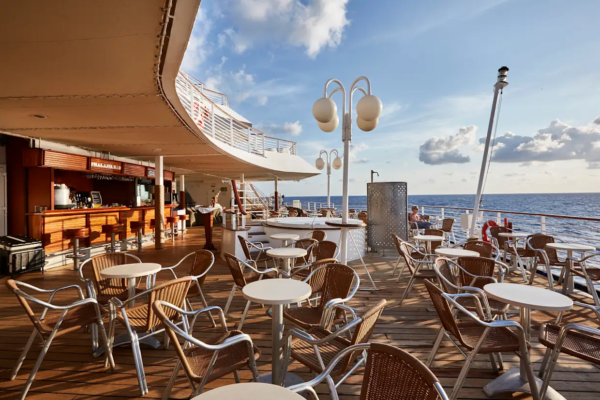
Early mornings are peaceful, with only the sound of waves breaking gently against the hull and the occasional call of seabirds circling overhead. Later, sunlight dances across the water as guests enjoy coffee, read beneath shaded lounges, or simply watch the changing coastline.
As evening approaches, the Mediterranean reveals another side of its beauty.
The sea reflects shades of gold, amber, and deep crimson while the sun slowly disappears beyond the horizon. Conversations linger over dinner. Music drifts through the ship. The lights of another island gradually fade into the distance as tomorrow’s destination waits somewhere beyond the darkness.
These moments rarely appear on an itinerary.
Yet they often become the memories travelers cherish most.
The Mediterranean is no longer simply a route connecting famous destinations.
It becomes a destination in its own right.
Every Port Reveals a Different Story
One of the greatest strengths of a Mediterranean cruise is the remarkable variety it offers.
Although each destination is connected by the same sea, every port reveals a completely different chapter of history, culture, and faith. Rather than feeling repetitive, the journey becomes richer with every stop, allowing travelers to experience the Mediterranean through constantly changing perspectives.
Athens – Where Ancient Civilization Meets Early Christianity
Few cities in the world combine history and faith as naturally as Athens.
Known as the birthplace of democracy and Western philosophy, the Greek capital also occupies an important place in Christian history. It was here that St. Paul stood before the Areopagus and delivered one of his most significant sermons, speaking to philosophers about the “Unknown God.”
Walking through Athens today means experiencing these two worlds side by side.
The Acropolis continues to dominate the skyline just as it has for centuries, while nearby neighborhoods are filled with lively cafe, local markets, and quiet streets where ancient history blends seamlessly into everyday life. Every corner offers another reminder that the city’s influence extends far beyond Greece itself.
For many travelers, Athens is far more than the beginning of a cruise itinerary.
It is the place where one of history’s greatest conversations between faith and culture first unfolded.
Ancient Corinth – Following the Footsteps of St. Paul
If Athens introduces travelers to the world of ancient Greece and early Christianity, Ancient Corinth brings the story of St. Paul even closer.
Located between mainland Greece and the Peloponnese, Corinth was once one of the most important cities of the ancient Mediterranean. Its strategic position made it a major center of trade, connecting different parts of the Greek and Roman worlds. For early Christians, however, Corinth became especially significant because of St. Paul’s missionary work and the Christian community that developed here.
Walking among the ruins today offers a fascinating contrast between the scale of the ancient city and the simplicity of the landscape surrounding it. Columns, temples, roads, and remnants of public buildings provide a glimpse into the world that St. Paul encountered nearly two thousand years ago.
For travelers on a pilgrimage cruise, this is where history becomes more than something read in a guidebook. The stories of the New Testament are connected to an actual landscape, allowing visitors to imagine the communities, conversations, and challenges faced by the early Christians who lived here.
Ancient Corinth is therefore not simply another archaeological stop. It is an opportunity to experience one of the places where the early Christian story unfolded.
Patmos – The Island of Revelation
After the historical depth of Corinth, Patmos offers a completely different atmosphere.
Small, peaceful, and surrounded by the deep blue waters of the Aegean Sea, Patmos is best known for its connection to St. John and the Book of Revelation. According to Christian tradition, St. John was exiled to the island, where he received the visions recorded in the final book of the New Testament.
The spiritual significance of Patmos is immediately apparent, but what makes the experience particularly memorable is the island’s quiet character. There is none of the intensity associated with a major European capital. Instead, the whitewashed buildings, narrow streets, hillsides, and expansive views of the Aegean create an environment that naturally encourages visitors to slow down.
A visit to the Cave of the Apocalypse adds another dimension to the experience. For pilgrims, standing in a place associated with one of the most important texts in Christian history can transform an abstract biblical story into something much more tangible.
The experience is not necessarily about seeing as much as possible.
It is about having enough time to pause, reflect, and appreciate the significance of where you are.
That is one of the reasons Patmos has remained an important pilgrimage destination for centuries.
Santorini and Mykonos – Another Side of the Greek Islands
A Mediterranean journey would not be complete without experiencing the visual beauty that has made the Greek Islands famous around the world.
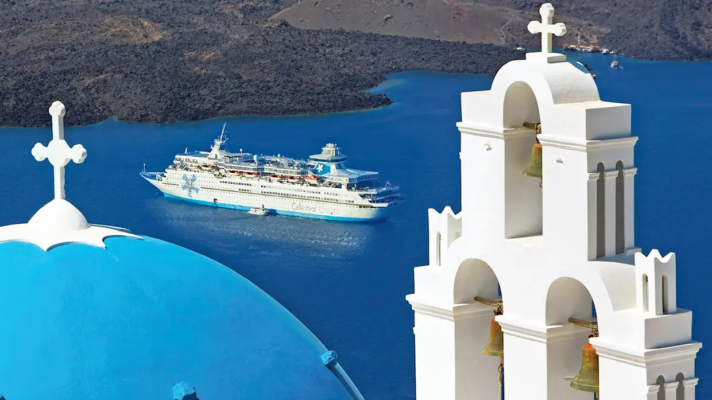
Santorini introduces a dramatic change of scenery. The island’s whitewashed villages, blue-domed churches, volcanic cliffs, and brilliant Aegean waters create one of the most recognizable landscapes in Greece. Arriving by sea adds another layer to the experience, as the island gradually rises from the horizon before revealing the villages perched high above the caldera.
After the historical and spiritual depth of destinations such as Corinth and Patmos, Santorini offers travelers the opportunity to simply enjoy the beauty of the Mediterranean.
Mykonos brings yet another character to the journey. Its narrow streets, whitewashed buildings, traditional windmills, small chapels, and waterfront cafés create a distinctly Greek atmosphere that has attracted travelers for generations.
Together, Santorini and Mykonos demonstrate another strength of a Mediterranean cruise: the ability to experience different sides of Greece within a single journey. Ancient history, Christian heritage, island traditions, dramatic landscapes, and contemporary Mediterranean life can all exist within the same itinerary.
The destinations may be different, but the sea connects them all.
Why a Pilgrimage Cruise Is Different
A traditional pilgrimage often focuses on a specific religious destination. Travelers arrive, visit the sacred site, attend a service or prayer, and continue to the next stop.
A pilgrimage cruise offers a different rhythm.
The journey itself becomes part of the experience.
Instead of moving quickly between cities, travelers have time to absorb the significance of each destination before continuing across the Aegean. The ship provides a comfortable space to rest, reflect, and prepare for the next day, while the changing landscape outside the window constantly reminds you that the journey is still unfolding.
This is particularly meaningful when the itinerary connects places associated with the life and ministry of St. Paul.
Athens introduces the world in which he preached. Ancient Corinth reveals one of the communities he served. Patmos connects the journey with St. John and the Book of Revelation. Other destinations add layers of Greek culture, Mediterranean history, and Christian heritage.
Rather than experiencing these places as isolated stops, travelers begin to see them as chapters in one larger story.
That is what makes a pilgrimage cruise different from simply visiting a collection of famous landmarks.
It creates connections.
Connections between history and faith. Between ancient civilizations and the modern Mediterranean. Between the stories travelers have read for years and the landscapes they can finally experience in person.
And perhaps most importantly, it creates space for reflection.
A day spent exploring an archaeological site can be followed by a quiet evening at sea. A visit to a sacred place can be followed by time on deck, watching the sun disappear over the horizon. There is a natural balance between discovery and stillness that is difficult to achieve on a fast-paced land itinerary.
When the Journey Becomes Part of the Memory
After a long journey, travelers often remember the obvious moments first: the famous landmarks, the photographs, the beautiful landscapes.
But memories have a way of becoming more personal with time.
Perhaps what remains is the morning coffee enjoyed while watching the Aegean Sea. Maybe it is the conversation shared with a fellow traveler after visiting an ancient Christian site. It could be the silence inside a chapel, the first view of Patmos from the ship, or the moment Santorini appeared beyond the horizon.
These moments may not have appeared on the original itinerary.
Yet they become part of the story.
That is one of the reasons the Mediterranean cruise experience can feel so different from a conventional vacation. The journey does not end when you leave the port. The hours spent sailing, resting, dining, reflecting, and watching the sea gradually become part of what you remember about the destinations themselves.
The ship connects the places, but it also gives travelers the time to appreciate them.
More Than a Vacation: A Journey Through History, Culture, and Faith
There are many ways to explore Greece and Türkiye.
Some travelers come for the islands. Others are drawn by ancient history, Mediterranean culture, food, architecture, or the beauty of the Aegean Sea.
For pilgrims, however, the journey can carry an additional meaning.
Following the footsteps of St. Paul across the Mediterranean creates an opportunity to encounter places that played an important role in the history of early Christianity while experiencing the landscapes and cultures that continue to define the region today.
The experience is not about rushing from one landmark to another.
It is about allowing each destination to tell its own story.
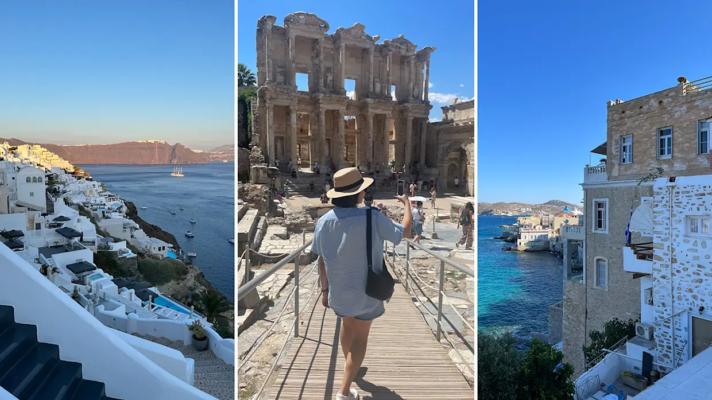
Athens speaks of philosophy, democracy, and the encounter between the ancient world and Christianity. Corinth recalls the communities and challenges of the early Church. Patmos invites reflection through its connection with St. John and the Book of Revelation. Santorini and Mykonos reveal the enduring beauty and culture of the Greek Islands.
And connecting them all is the Aegean Sea.
Perhaps that is what makes a Mediterranean pilgrimage cruise so memorable. It brings together experiences that might otherwise require several different journeys and allows travelers to encounter them as part of one continuous story.
Every Morning, Another Chapter Begins
In the end, the greatest appeal of a Mediterranean cruise may be remarkably simple.
You wake up, open the curtains, and discover somewhere new.
One morning, it may be the ancient landscape of Corinth. Another begins with the peaceful hills of Patmos. Later, the white villages of Santorini appear against the blue Aegean sky, followed by the unmistakable charm of Mykonos.
Yet the most important change may not be the view outside the window.
It may be the way you experience the journey itself.
There is something deeply rewarding about knowing that you can explore remarkable destinations without constantly packing your suitcase, changing hotels, or worrying about the next transfer. Your cabin remains your home while the world outside continues to change.
For a pilgrimage journey, that sense of continuity becomes even more meaningful. It gives travelers the freedom to move between history, culture, and faith without losing the sense of reflection that makes pilgrimage different from ordinary tourism.
Long after the photographs have been shared and the suitcase has been unpacked, what remains may be a collection of quiet memories: the first glimpse of an island at sunrise, the sound of the sea from the deck, an ancient road once walked by St. Paul, a moment of silence in Patmos, or the sight of Santorini appearing on the horizon.
The destinations may eventually become names on a map.
But the journey connects them into something much more personal.
A story that begins with the sea, passes through centuries of history and faith, and continues long after the ship has returned to port.
Begin Your Mediterranean Journey
If you are looking for a different way to experience Greece and Türkiye, a Mediterranean pilgrimage cruise offers the opportunity to combine “the beauty of the Aegean Sea, the culture of the Greek Islands, ancient Christian heritage, and the comfort of cruising” in one meaningful journey.
Discover the places connected to the footsteps of St. Paul, experience the peaceful atmosphere of Patmos, explore Ancient Corinth, and wake up each morning to a new view of the Mediterranean.
Your next destination may be only one sunrise away!
Explore the Mediterranean Cruise journey with Carnival US Travel and begin a voyage where every destination tells a story.