
Places & Experiences
Neuschwanstein Castle – Germany’s Fairytale Castle
Neuschwanstein Castle – The Fairytale That Became Germany’s Most Famous Landmark
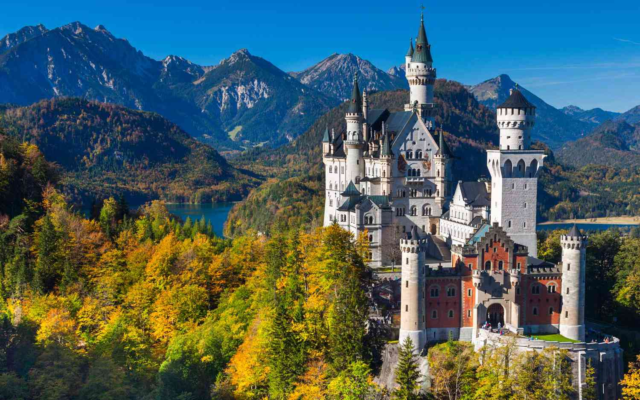
Long before visitors catch their first glimpse of Neuschwanstein Castle, they usually see it in fragments. The white limestone towers appear briefly between evergreen forests as the road winds through Bavaria. A distant silhouette rises above the hills, disappearing behind mountain ridges before returning again from another angle. It is only after climbing higher that the entire castle reveals itself, perched dramatically above the valley as though it has always belonged to the landscape.
For many travelers, that first view feels strangely familiar.
Even those who have never been to Germany often recognize the castle immediately. Its soaring towers, steep slate roofs, and romantic setting have inspired countless illustrations, films, and perhaps most famously, the image of the fairy-tale castle that generations associate with childhood stories. Yet Neuschwanstein is far more than an architectural fantasy. Behind its dreamlike appearance lies a remarkable story about ambition, solitude, imagination, and a king determined to create a world that reflected his own ideals rather than political reality.
Understanding that story changes the experience of visiting the castle. Instead of seeing it simply as one of Germany’s most photographed attractions, travelers begin to appreciate it as the personal vision of a man whose dreams outlived his own lifetime.
The Vision of King Ludwig II
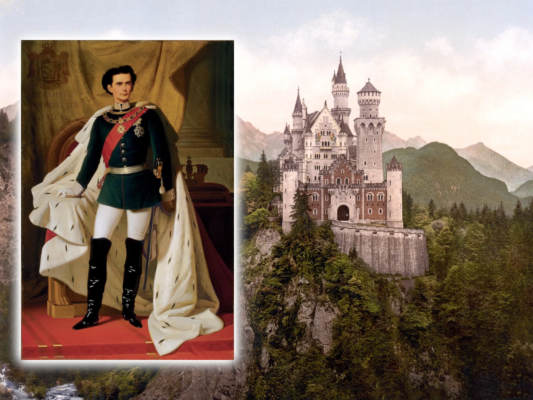
Neuschwanstein Castle owes its existence to King Ludwig II of Bavaria, a monarch remembered as much for his imagination as for his eccentricity. Ascending the throne at just eighteen years old, Ludwig inherited a kingdom undergoing enormous political change. Bavaria’s independence was gradually giving way to a newly unified Germany, leaving the young king with less influence over public affairs than many of his predecessors.
Rather than embracing political life, Ludwig turned toward art, music, and architecture. He admired the operas of Richard Wagner, whose legends of medieval knights and heroic kingdoms shaped the king’s imagination. Inspired by those stories, Ludwig envisioned a castle that celebrated the ideals of chivalry, romance, and beauty – a place that existed not for military defense but as a private retreat from the demands of the modern world.
Construction began in 1869, yet the project remained unfinished at the time of Ludwig’s death. Ironically, the castle that had been intended as his personal sanctuary was opened to the public only weeks later in order to help repay the enormous debts created during its construction.
Today, millions of visitors each year walk through halls that Ludwig himself enjoyed for only a brief period, transforming his private dream into one of Europe’s greatest cultural landmarks.
More Than a Castle, It Is a Masterpiece of Setting
Architecture alone cannot explain why Neuschwanstein leaves such a lasting impression. Its true power lies in the relationship between the building and its surroundings.
Located in the Bavarian Alps near the village of Hohenschwangau, the castle overlooks forests, lakes, rolling meadows, and mountain peaks that change dramatically with each season. In spring, fresh greenery softens the landscape. Summer fills the valleys with vibrant color, while winter blankets the towers in snow, creating scenes that seem almost unreal.
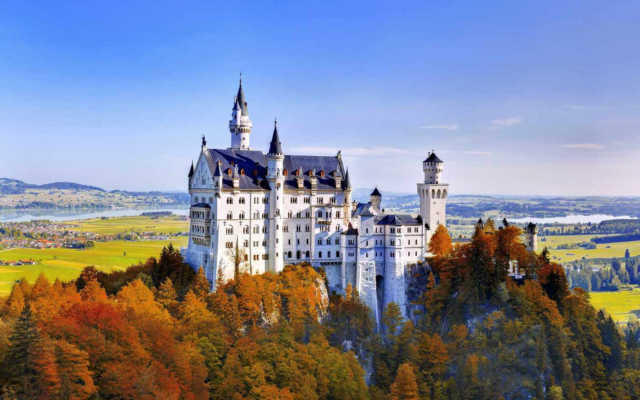
Autumn, however, offers perhaps the most captivating balance. Forests surrounding the castle glow in shades of amber, crimson, and gold, while crisp mountain air often provides exceptional visibility across the alpine landscape. Walking toward the castle beneath colorful trees feels less like approaching a tourist attraction and more like entering the setting of a story that has quietly unfolded for centuries.
Few places in Europe demonstrate so clearly how architecture can become part of nature rather than simply occupying it.
The Best View Isn’t Inside the Castle
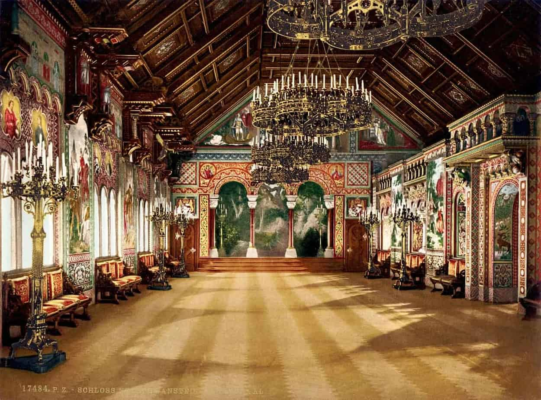
Many first-time visitors assume the highlight of Neuschwanstein will be its lavish interiors. While the throne room, singers’ hall, and richly decorated chambers are impressive, experienced travelers often agree that the most unforgettable moments happen outside.
A short walk from the castle leads to Marienbrücke, or Mary’s Bridge, suspended high above the Pöllat Gorge. From here, visitors enjoy the view that has become synonymous with Neuschwanstein itself: soaring white towers framed by mountains and dense forests stretching toward the horizon.
Standing on the bridge, it becomes easy to understand why photographers return throughout the year. Every season transforms the landscape into something entirely new. Morning mist rises through the valley in early autumn, summer light illuminates distant peaks, and winter snow simplifies the scenery into striking contrasts of white, gray, and dark green.
The castle is magnificent on its own, but it is this wider landscape that elevates the experience into something extraordinary.
Why Neuschwanstein Continues to Inspire Travelers
Europe is filled with magnificent castles, each reflecting different periods of history, architecture, and royal ambition. What distinguishes Neuschwanstein is not that it is the oldest or the largest. In fact, compared with many medieval fortresses, it is surprisingly young.
Its uniqueness lies in emotion rather than age.
The castle represents an idealized vision of beauty at a time when Europe was rapidly industrializing. It celebrates imagination over practicality, romance over politics, and craftsmanship over efficiency. Visitors are drawn not simply by history but by the feeling that such places should not exist – and yet somehow do.
Perhaps this explains why Neuschwanstein resonates with travelers of every generation. Children see a fairy-tale castle. History enthusiasts discover the fascinating story of King Ludwig II. Architects admire remarkable nineteenth-century craftsmanship. Photographers find endless compositions shaped by changing light and dramatic scenery.
Each visitor arrives for a different reason, yet nearly everyone leaves with the same impression: the castle is even more extraordinary in person than in photographs.
Experience Bavaria with Carnival US Travel
Neuschwanstein Castle is one of the highlights of Carnival US Travel’s European journeys, thoughtfully included as more than a sightseeing stop. Visiting Bavaria offers the opportunity to experience not only one of Germany’s most iconic landmarks but also the region’s alpine scenery, charming villages, and cultural traditions that have shaped this remarkable part of Europe for centuries.
Whether it is your first visit to Germany or another chapter in a lifelong love of European travel, Neuschwanstein reminds every traveler that some places continue to inspire long after the journey has ended.
Contact Carnival US Travel
📍 Serving San Jose, the Bay Area, and Vietnamese communities across the United States.
📞 669-292-7688 | 669-265-7814
🌐 https://www.facebook.com/carnivalinus